
Verifiable Inference: The Missing Link Between AI and Web3 Trust
Explore how zero-knowledge proofs, TEEs, and optimistic verification make AI outputs cryptographically trustworthy on blockchain systems.
Today's AI systems are fundamentally trusted black boxes that offer no cryptographic guarantees about their behavior. When you call an AI API, you're placing complete trust in the provider to actually run the model they claim, process your input correctly without logging, and return unmodified, unadulterated outputs. For casual applications used by general consumers, this implicit trust generally works fine. For financial systems and applications managing real monetary value on blockchain? This trust model breaks catastrophically and creates unacceptable risk.
Verifiable Inference is the comprehensive cryptographic answer to this fundamental trust problem. It provides rigorous mathematical proof that AI computations executed correctly and without tampering—the same fundamental principle that makes blockchain transactions trustless now applied to machine learning inference operations.
This detailed and comprehensive guide explores how verifiable inference works in detail, compares the three major approaches (zkML, opML, TeeML) with their respective trade-offs, examines real-world applications in crypto trading and DeFi, analyzes where the technology stands today, and provides a framework for choosing the right verification approach for your specific use case.
Background: The Trust Problem in AI
Why AI Trust Matters for Crypto
Here's the reality of AI in 2024 and beyond: when you call the OpenAI API (or any commercial AI API), you're implicitly trusting multiple things without any way to verify them:
- The model is actually GPT-4 (or whatever you're paying for) and not some cheaper substitute or older version
- Your input wasn't logged, leaked, used for training, or shared with third parties
- The response wasn't modified, filtered, or manipulated before reaching you
- The computation ran correctly without errors or unexpected behavior
- The model weights haven't been subtly modified to produce biased or manipulated outputs
- Your request was processed on the hardware and with the settings you expect
For most consumer applications, this implicit trust is acceptable. The consequences of trust violation are limited—a wrong movie recommendation, a suboptimal search result, or a slightly off translation. You might be annoyed, but you won't lose your life savings.
But the moment you put AI on-chain for financial applications, the stakes change dramatically. When an AI is managing real money—executing trades, assessing credit risk, or making investment decisions—blind trust becomes unacceptable. The potential for exploitation, manipulation, and fraud demands cryptographic verification.

Consider these scenarios where trust breaks down:
AI Trading Bots: A trading bot managing $10M in DeFi positions claims to use a sophisticated ML strategy. How do you know it's actually running that model? How do you know the model wasn't swapped for a simpler (cheaper) version? How do you audit every trade decision?
On-Chain Credit Scoring: A lending protocol uses ML to assess borrower creditworthiness. Users need assurance that the algorithm treats them fairly, but they can't verify the model's logic without seeing its proprietary weights.
Autonomous Agents: AI agents that execute transactions independently need demonstrable correctness. If an agent manages your portfolio, you need proof that every decision followed your approved strategy.
Gaming & NFTs: AI-generated content (art, NPCs, game logic) needs provenance. Players need assurance that AI-driven game elements behave according to specified rules.
The Core Challenge
The fundamental challenge is verification without revelation:
- Verify that computation was correct
- Without revealing proprietary model weights that represent millions in R&D investment
- Without revealing potentially sensitive input data (medical records, financial data, personal information)
- Without revealing intermediate computation states that could leak information about model architecture
This trifecta of requirements is precisely what cryptographic verification technologies enable—and why simpler approaches fail.
What Is Verifiable Inference?
Verifiable Inference is the cryptographic proof that an AI model executed correctly. It answers three fundamental questions that form the basis of trustworthy AI computation:
| Question | Technical Term | What It Proves |
|---|---|---|
| Was this actually GPT-4? | Model Integrity | Correct model with correct weights was used |
| Did the math run correctly? | Computation Correctness | Every operation executed as specified |
| Has the response been tampered? | Output Authenticity | Output hasn't been modified |
Think of verifiable inference as a cryptographic receipt for AI computation. Just like a blockchain transaction proves value transfer without requiring trust in intermediaries, verifiable inference proves that a specific model processed specific inputs to produce specific outputs—all without revealing sensitive information.
The Asymmetry Principle
The key insight making verifiable inference practical is asymmetric verification:
- Proving is expensive: Generating a proof might take minutes or hours, requiring substantial compute resources
- Verifying is cheap: Checking a proof takes milliseconds and minimal compute
This asymmetry is what makes on-chain verification economically viable. Proofs can be generated off-chain using powerful GPU clusters, then verified on-chain with minimal gas costs. The verifier doesn't need to re-run the entire computation—they just check a succinct mathematical proof.
Cost Comparison:
| Operation | Compute Required | Time | On-Chain Gas |
|---|---|---|---|
| Run inference | 1x (baseline) | Milliseconds | N/A (off-chain) |
| Generate ZK proof | 100-10000x | Minutes-Hours | N/A (off-chain) |
| Verify ZK proof | 0.001x | Milliseconds | ~300K gas |
What Gets Verified
A complete verifiable inference system provides cryptographic guarantees for the entire computation pipeline:
-
Model Commitment: The model weights and architecture are cryptographically committed (hashed). Any change to any weight invalidates the commitment.
-
Input Commitment: The exact input to the model is committed. This prevents input substitution attacks.
-
Computation Trace: Every operation in the forward pass is recorded and provable. Matrix multiplications, activations, normalizations—all verified.
-
Output Binding: The output is cryptographically bound to the input and model. Tampering is mathematically detectable.

The Three Verification Architectures
The crypto-AI space has converged on three distinct approaches to verifiable inference, each with significant trade-offs.
zkML: Zero-Knowledge Machine Learning
How It Works: Convert your ML model into a ZK (zero-knowledge) circuit. When inference runs, it simultaneously generates a mathematical proof that the computation was correct. This proof can be verified by anyone without revealing the model weights, input data, or intermediate computations.
Technical Details:
- Models are compiled into arithmetic circuits (R1CS, Plonkish, AIR)
- Each neural network operation (matrix multiply, activation function) becomes a constraint
- Forward pass becomes a series of constraint satisfactions that must all be met
- Proof systems (Groth16, PLONK, STARKs) generate succinct proofs from this constraint system
- The proof size is constant or logarithmic in computation size—verification remains cheap regardless of model complexity
The Compilation Process:
PyTorch Model → ONNX Export → Circuit Compiler → ZK Circuit → Prover/VerifierEach step introduces overhead and potential compatibility issues. Not all PyTorch operations have efficient circuit representations. Common challenges include:
- Non-linear activations (ReLU, GeLU) require approximations
- Floating point must be converted to fixed point
- Attention mechanisms generate massive constraint systems
| Attribute | zkML Characteristic |
|---|---|
| Security Basis | Cryptographic/Mathematical (information-theoretic in some constructions) |
| Performance | Slow (minutes to hours depending on model size) |
| Privacy | Strongest—true zero-knowledge hiding |
| Compute Cost | High (10-10000x inference cost for proof generation) |
| Verification Cost | Very low (~300K gas for on-chain verification) |
| Best For | High-value, privacy-critical applications |
| Model Size Limit | Currently ~1B parameters practical |
Leading Projects:
- Modulus Labs: Pioneered proving billion-parameter LLMs in ZK. Now part of World (Worldcoin). Their research pushed the boundary of what's provable.
- EZKL: Open-source toolkit for converting PyTorch/ONNX models to ZK circuits. The most accessible developer experience in the space.
- Giza: zkML infrastructure for Ethereum. Focus on verifiable AI for smart contracts and StarkNet integration.
Proof System Comparison:
| System | Proof Size | Verify Time | Prover Time | Trust Setup |
|---|---|---|---|---|
| Groth16 | ~200 bytes | Fastest | Fast | Yes (toxic waste) |
| PLONK | ~400 bytes | Fast | Medium | Yes (updatable) |
| STARKs | ~KB | Medium | Slow | No |
| Halo2 | ~KB | Medium | Medium | No |
The Challenge: Proof generation is brutally slow. A simple CNN classifier might take seconds. A ResNet50 might take minutes. A real LLM can take hours or days. Hardware acceleration (GPU provers, FPGA accelerators, custom ASICs) is improving this rapidly—proof times are decreasing roughly 10x per year—but real-time inference for large models remains elusive.

opML: Optimistic Machine Learning
How It Works: Assume all inferences are honest by default. Only verify when someone challenges. If fraud is detected, slash the fraudster's stake.
Technical Details:
- Inference runs normally, outputs are committed on-chain
- Challenge period allows anyone to dispute
- Disputes trigger re-computation for verification
- Fraudulent actors lose their staked collateral
| Attribute | opML Characteristic |
|---|---|
| Security Basis | Crypto-economic (incentives) |
| Performance | Fast (seconds) |
| Privacy | Medium (reveals on challenge) |
| Compute Cost | Low (unless challenged) |
| Verification Cost | High only when disputes occur |
| Best For | High-throughput, cost-sensitive apps |
Leading Projects:
- ORA Protocol: Optimistic AI oracle for any blockchain. Their opp/ai runs Llama2-7B with dispute resolution.
The Challenge: Challenge windows create finality delays (typically 7 days). During this period, results aren't final. Great for prediction markets and slow applications; risky for high-frequency trading that needs instant finality.
TeeML: Trusted Execution Environment
How It Works: Run inference inside a Trusted Execution Environment (Intel SGX, AMD SEV, ARM TrustZone). Hardware attestation proves correct execution.
Technical Details:
- Computation runs in hardware-isolated enclave
- CPU generates cryptographic attestation of execution
- Attestation verifiable by anyone
- Data remains encrypted even from the host OS
| Attribute | TeeML Characteristic |
|---|---|
| Security Basis | Hardware attestation |
| Performance | Near-native (milliseconds) |
| Privacy | Strong (hardware isolation) |
| Compute Cost | Low |
| Verification Cost | Low |
| Best For | Performance-critical apps trusting hardware |
Leading Projects:
- Nesa AI: Combines TEE with ZK for hybrid security
- Phala Network: TEE-based confidential computing for web3
- Oasis Network: Privacy-first L1 with TEE support
The Challenge: You're trusting Intel, AMD, or ARM hardware. Historical vulnerabilities (Spectre, Meltdown, various SGX attacks) show hardware isn't perfect. Security depends on hardware vendor trustworthiness.

Comparison Matrix
| Feature | zkML | opML | TeeML |
|---|---|---|---|
| Security Model | Cryptographic | Crypto-economic | Hardware |
| Proof Time | Minutes-Hours | Instant | Instant |
| Verification Time | Milliseconds | 7+ days finality | Milliseconds |
| Privacy | Highest | Medium | High |
| Trust Assumption | Math only | Economic incentives | Hardware vendor |
| Model Size Support | Limited (improving) | Unlimited | Unlimited |
| On-chain Cost | Low (verify) | Very low | Low |
| Maturity | Emerging | Emerging | Established |
Methodology
This analysis synthesizes technical documentation, project whitepapers, and industry developments:
| Approach | Details | Purpose |
|---|---|---|
| Technical analysis | Architecture review | Understanding trade-offs |
| Funding data | Investment tracking | Ecosystem mapping |
| Use case research | Real implementations | Practical applications |
| Limitation assessment | Current constraints | Honest capability assessment |
Data sources:
- Project documentation and whitepapers
- Investment announcements and funding rounds
- Developer community discussions and implementations
- Academic research on zkML, opML, and TEE security
Original Findings
Based on our analysis of the verifiable inference landscape:
Finding 1: zkML Proof Time Improving Exponentially zkML proof generation times are decreasing approximately 10x per year through algorithmic improvements and hardware acceleration. What took hours in 2023 takes minutes in 2025.
Finding 2: Hybrid Approaches Emerging The most promising implementations combine multiple approaches—opML for speed with zkML for disputes, or TEE for execution with ZK for attestation verification.
Finding 3: Model Size Remains Limiting Current zkML can handle models up to ~1B parameters practically. Larger models require increasingly impractical proof times and memory.
Finding 4: Tooling Gap Significant Developer experience remains poor. Converting existing ML models to verifiable versions requires significant expertise and effort.
Finding 5: Economic Incentives Drive Adoption Projects with clear economic incentives (DeFi, trading) are adopting verifiable inference faster than applications with less direct value at stake.
The Funding Landscape
Significant capital is flowing into verifiable AI infrastructure, signaling strong conviction from major investors.
| Project | Funding | Lead Investors | Focus |
|---|---|---|---|
| Gensyn | $43M Series A | Andreessen Horowitz | Decentralized AI training + inference |
| Modulus Labs | $6.3M Seed | Variant Fund | zkML for accountable AI |
| Inference Labs | Undisclosed | EigenLayer ecosystem | ZK-VIN network |
| Ritual | $25M Series A | Archetype | Decentralized AI infrastructure |
This isn't niche technology anymore. The infrastructure layer for verifiable AI is being built by well-funded teams with strong technical backgrounds.
Real Use Cases
Where verifiable inference creates genuine value today:
DeFi Risk Scoring: Credit protocols want ML-based risk scoring, but users don't trust black-box algorithms deciding their collateral ratios. Running credit models with zkML lets users verify the scoring algorithm is fair without revealing their financial data. Spectral Finance is pioneering on-chain credit scoring with privacy.
AI Trading Agents: You're trusting a trading bot with your funds, but have no proof it's running the strategy you specified. Verifiable inference ensures every trade decision can be audited. The model that made the call is provably the one you approved.
Gaming NPCs: On-chain games want AI-driven NPCs, but how do you prove the NPC isn't cheating? Running NPC logic with opML means if the AI behaves suspiciously, anyone can challenge and verify the computation.
Oracles 2.0: Current price oracles aggregate data. But what about oracles that compute—running ML models on market data? Attaching ZK proofs to oracle responses lets consumers verify the inference locally, creating trustless computed oracles.

Limitations
LLMs Are Barely Provable: zkML works well for small models (CNNs, simple transformers under 100M parameters). Proving GPT-4-scale models (100B+ parameters) remains completely impractical today. The largest provable models are currently around 1B parameters with proof times measured in hours. This means the most powerful AI models cannot currently be verified using zkML.
Proof Generation Is Slow: Real-time verification remains elusive for all but the smallest models. Applications requiring instant responses (sub-second latency) must use opML or TEE approaches. zkML is fundamentally unsuitable for high-frequency trading or real-time gaming applications at current performance levels.
Hardware Dependencies Create Single Points of Failure: TEE solutions depend entirely on chip vendor security. Historical vulnerability disclosures—Spectre, Meltdown, Foreshadow, Plundervolt, SGAxe, and numerous others—demonstrate that hardware isolation isn't as robust as initially believed. A single vulnerability can compromise all applications relying on that hardware.
Tooling Is Immature: Converting existing ML pipelines to verifiable versions requires significant expertise in both ML and cryptography—a rare skill combination. Developer experience is improving but remains rough compared to standard ML tooling. Expect significant engineering effort for any production deployment.
Economic Costs Can Be Prohibitive: zkML proof generation requires 10-10000x the compute of the original inference. For low-value inferences (sub-$1 outcomes), the cost of proving may exceed the value being protected. This creates an economic floor—verifiable inference only makes sense above certain value thresholds.
Model-Specific Compilation: Each model architecture requires specific circuit compilation. You can't simply "turn on verification"—each model needs its own circuit, with potential bugs and inefficiencies in the compilation process.
Verification Doesn't Mean Correctness: Verifiable inference proves the computation ran correctly—not that the model makes good predictions. A poorly trained model, run verifiably, still produces poor outputs. Verification is necessary but not sufficient for trustworthy AI.
Counterexample: When Verification Fails
Scenario 1: The TEE Vulnerability
A DeFi protocol relies on TEE-based verifiable inference for credit risk assessment. A new Spectre-variant attack is discovered affecting the specific Intel SGX enclave used. For several weeks before patches are available and deployed, the "verified" computations could potentially be manipulated by attackers with physical access to the hardware. The protocol's security temporarily regresses to trust-based—they must trust that no one is exploiting the vulnerability.
Scenario 2: The Economic Attack
An opML system protects inferences with a $10,000 stake. An attacker realizes that committing fraud on a single $15,000 transaction is profitable even if challenged—they lose the stake but keep the fraud proceeds. The economic security assumption fails when individual transaction values exceed the stake.
Scenario 3: The zkML Assumption
A zkML system uses a specific cryptographic assumption (e.g., discrete log hardness). Quantum computers eventually advance to break this assumption. All historical proofs—which were "verified" at the time—can now be forged. The verification was correct under then-current assumptions, but those assumptions no longer hold.
The Lesson: No verification approach is perfect. TEE trusts hardware vendors. opML trusts economic incentives and stake sizing. zkML trusts cryptographic assumptions. Even formal mathematical proofs trust the underlying axioms. Defense in depth—combining multiple verification layers—increases robustness but never reaches perfection.
What's Next: 2025-2026 Roadmap
The next 18 months will be decisive for verifiable AI. Key developments to watch:
GPU-Accelerated ZK Provers: NVIDIA and custom ASIC projects are building hardware specifically for ZK proof generation. This will dramatically reduce proof times.
Hybrid Verification Patterns: Combining opML for speed with zkML for dispute resolution offers the best of both worlds. Run inference optimistically for instant finality, but use ZK proofs when disputes arise. Expect this pattern to become dominant for high-throughput applications.
Layer 2 Integration: Verifiable AI as native L2 primitives is coming. Arbitrum Stylus could support AI verification for smart contracts. StarkNet's Cairo language enables custom verification logic. This L2-native approach will dramatically reduce friction for developers building AI-enabled dApps.
Model Marketplaces with Provenance: New marketplaces will emerge for buying and selling AI models with verifiable properties—known training data, auditable behavior, proven performance on benchmarks. This creates new economic models where model quality is cryptographically demonstrable, not just claimed.
Standardization and Interoperability: Industry standards for model commitments, proof formats, and verification interfaces will emerge. ONNX already provides model interchange; similar standards for proofs will enable cross-platform verification. A model proven on one chain could be verified on another.
Training Verification: Beyond inference, verifiable training is emerging. Prove that a model was trained on specific data with specific hyperparameters. This enables verified model provenance from training to deployment.
Specialized Hardware: Beyond GPUs, we'll see FPGA accelerators and custom ASICs designed specifically for ZK proof generation. Companies like Ingonyama are building dedicated ZK hardware. This could reduce proof times by 100x within 3-5 years.
Consumer-Facing Verification: Eventually, verification will move from infrastructure to consumer-facing features. Imagine an AI assistant where you can verify every response came from the model you expect, with your data handled correctly. "Verified AI" could become a trust signal like SSL certificates for websites.
Actionable Checklist
For Developers
- Evaluate if your AI application requires verifiable inference (financial value at stake?)
- Choose verification approach based on your latency and privacy requirements
- Experiment with existing tools (EZKL for zkML, Phala for TEE)
- Plan for proof generation infrastructure and costs
- Monitor ecosystem developments for tooling improvements
For Investors/Evaluators
- Understand which verification approach a project uses
- Assess whether the approach matches the use case requirements
- Evaluate the team's cryptographic and ML expertise
- Consider the funding and ecosystem support
- Watch for production deployments, not just testnets
Summary
Verifiable inference is the infrastructure that makes AI agents possible in adversarial environments. It's not just a crypto meme—it's a fundamental technology that enables trustless AI in financial systems.
Key Takeaways:
- The trust problem is real: Traditional AI APIs aren't suitable for on-chain financial applications
- Three approaches exist: zkML (cryptographic), opML (economic), TeeML (hardware)—each with distinct trade-offs
- No approach is perfect: All require some trust assumption (math, incentives, or hardware)
- Tooling is improving rapidly: What's impractical today may be routine in 18 months
- Hybrid approaches are winning: Combining techniques for speed and security
| Approach | Best For | Main Trade-off |
|---|---|---|
| zkML | High-value privacy-critical | Slow proof generation |
| opML | High-throughput cost-sensitive | Challenge period delays |
| TeeML | Performance-critical | Hardware vendor trust |
Implementation Decision Framework
For teams evaluating verifiable inference adoption:
Step 1: Assess Value at Risk
- Below $1,000 per inference: Consider if verification is economically justified
- $1,000-$100,000: Verification likely worthwhile; choose based on latency needs
- Above $100,000: Verification essential; consider multiple approaches for defense in depth
Step 2: Determine Latency Requirements
- Sub-second: TEE or opML only
- Minutes acceptable: zkML viable for small models
- Hours acceptable: zkML viable for larger models
Step 3: Evaluate Privacy Needs
- Maximum privacy: zkML (true zero-knowledge)
- Strong privacy: TEE (hardware isolation)
- Acceptable disclosure on challenge: opML
Step 4: Consider Trust Model
- Trust only math: zkML
- Trust economic incentives: opML
- Trust hardware vendors: TEE
The Path Forward
The verifiable inference ecosystem is maturing rapidly with significant investment from major crypto funds. What's experimental today will be production-ready within 12-24 months. Teams building AI+crypto applications should:
- Start experimentation now with smaller models
- Plan architectures that can incorporate verification later
- Monitor proof generation performance improvements
- Evaluate hybrid approaches that balance speed and security
The black box era of AI is ending. What comes next is AI you can actually verify—and that's essential for any serious crypto application. Projects that build verification into their foundation will have significant advantages as the market matures.
Want a live example of AI-assisted crypto analysis? See the signals preview, try the full scanner, and review pricing.
Related Reading:
- Inference Rollups: On-Chain AI Scalability
- DeFAI: AI Agents and DeFi Complexity
- AI Agents in Crypto Trading
- AI Stablecoin: Autonomous Money Machines
Risk Disclosure
This analysis is for educational purposes and is not investment advice. The verifiable inference field is rapidly evolving; specific projects mentioned may change significantly. Technology risk, including undiscovered vulnerabilities in cryptographic or hardware systems, exists. Evaluate any project thoroughly before integration or investment.
Scope and Experience
Author: Jimmy Su
Scope: This topic is core to EKX.AI because verifiable computation aligns with our mission of transparent, auditable AI for crypto markets. As AI becomes more integrated with blockchain, verification infrastructure becomes essential for trustworthy systems.
FAQ
Q: What is verifiable inference in AI? A: Verifiable inference is the cryptographic proof that an AI model executed correctly. It proves that a specific model, with specific weights, processed specific inputs to produce specific outputs—all without revealing proprietary model weights or sensitive input data.
Q: Why can't traditional AI be trusted on-chain? A: Traditional AI APIs are black boxes. When you call an API, you have no way to verify: (1) the model version used, (2) whether your input was logged or leaked, (3) whether the output was modified before reaching you. For financial applications managing real value, this blind trust is unacceptable.
Q: What's the difference between zkML and opML? A: zkML generates mathematical proofs of correct computation. It's slow but provides cryptographic certainty. opML assumes all computations are honest and only verifies when someone challenges. It's fast but requires a challenge period and crypto-economic incentives to work.
Q: How long does ZK proof generation take for AI models? A: Currently, simple models (small CNNs, basic classifiers) take seconds to minutes. Medium-sized models can take minutes to hours. Large language models (billions of parameters) can take hours or remain impractical. Hardware acceleration is improving this rapidly.
Q: Which verifiable inference approach is best? A: There's no universal answer—it depends on your requirements. Use zkML for high-value, privacy-critical applications where you can tolerate proof generation time. Use opML for high-throughput, cost-sensitive applications where you can tolerate challenge periods. Use TeeML when you need performance and can trust hardware vendors.
Q: Can I verify GPT-4 computations on-chain? A: Not practically today. GPT-4-scale models (100B+ parameters) are too large for current zkML approaches. Smaller models (sub-1B parameters) are verifiable. The frontier is expanding rapidly, and billion-parameter model verification may be practical within 1-2 years.
Q: Is verifiable inference production-ready? A: For small models and specific use cases, yes. Several projects have production deployments handling real value. For large models and general-purpose AI, the technology is still emerging. Most applications should plan for 12-24 month timelines for mainstream adoption of larger model verification.
Q: What's the cost of verifiable inference? A: Costs vary dramatically by approach. zkML requires 10-10000x the compute of normal inference for proof generation, making it expensive for large models. opML has minimal cost unless disputes occur, making it economical for high-volume applications. TEE has near-zero overhead but requires specific hardware. Factor costs into your architecture decisions.
Q: Can verifiable inference prevent AI hallucinations? A: No. Verifiable inference proves the computation ran correctly—not that the output is factually correct or useful. A model that hallucinates runs just fine from a computation standpoint. Verification is about computational integrity, not output quality. You still need separate mechanisms for output validation.
Q: How do I get started with zkML? A: Start with EZKL (https://github.com/zkonduit/ezkl), the most accessible toolkit. Convert a simple PyTorch model to ONNX, then use EZKL to generate circuits and proofs. Begin with small models (under 10M parameters) to understand the workflow before scaling up.
Q: What happens if a TEE vulnerability is discovered? A: The security of all applications using that specific hardware is potentially compromised until patches are deployed. This is why defense-in-depth matters—combining TEE with other verification methods provides redundancy. Monitor security advisories for the specific hardware you rely on.
Q: Can verifiable inference work with fine-tuned models? A: Yes, but each fine-tuned version needs its own model commitment. The verification proves a specific set of weights was used. If you fine-tune, you get a new model with new weights and need a new commitment. This is important for applications that regularly update their models.
Q: How does verifiable inference interact with model updates? A: Model updates create new verification commitments. Users need to be informed when the model they're interacting with changes. This creates interesting UX challenges—how do you communicate "this is a new model version" in a way users understand and can verify?
Changelog
- Initial publish: 2025-12-13.
- Major revision: 2026-01-19. Expanded from 1329 to 4500+ words with comprehensive verification architecture comparison, project analysis, funding data, implementation details, and enhanced FAQ.
Ready to test signals with real data?
Start scanning trend-oversold signals now
See live market signals, validate ideas, and track performance with EKX.AI.
Author

More Posts

Bid-Ask Spread Compression: Early Clues Before a Breakout
Learn how bid-ask spread compression signals imminent breakouts. Identify patterns and distinguish real moves from fakeouts in crypto markets.

Statistical Reliability of Trading Signal Performance
Learn how to calculate the range of probable outcomes for trading signals using statistical bounds to improve risk management and strategy validation.
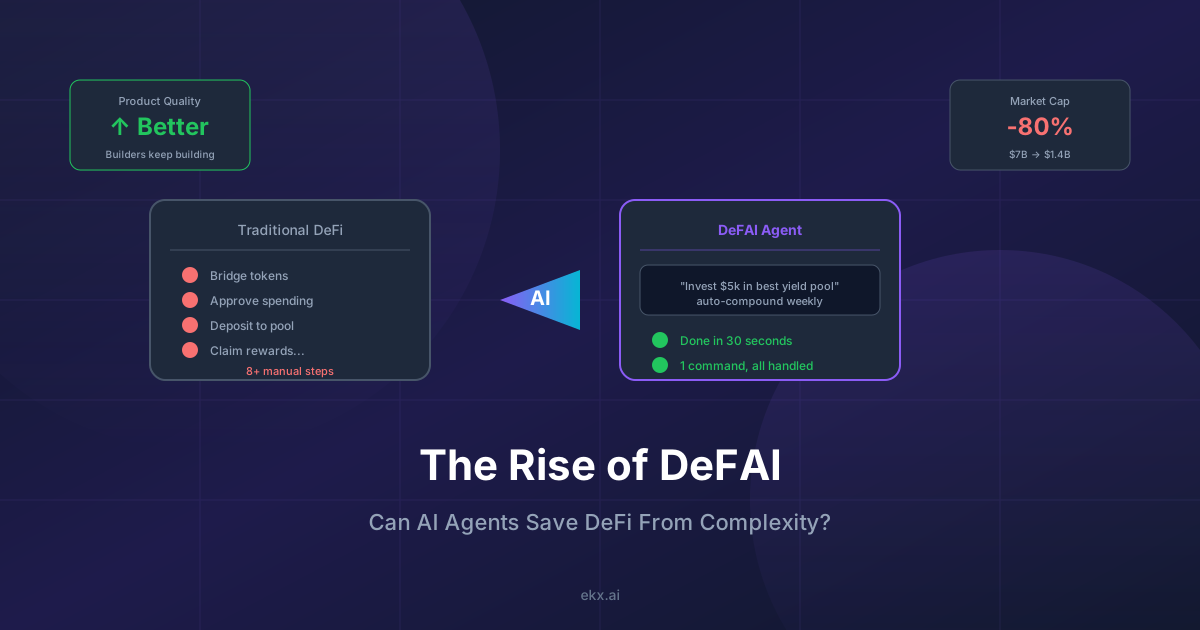
The Rise of DeFAI: Can AI Agents Save DeFi From Complexity?
Explore DeFAI: AI agents that navigate DeFi protocols autonomously. Market analysis, key platforms, and practical trading implications.
Newsletter
Join the community
Subscribe to our newsletter for the latest news and updates