Inference Rollups: The Hidden Infrastructure Powering On-Chain AI
Deep dive into inference rollups: how zkML and opML enable trustless on-chain AI computation. Key projects, tradeoffs, and market implications.
Running AI on blockchain is expensive. Absurdly expensive. A simple 1000x1000 matrix multiplication would cost over 3 billion gas on Ethereum. That exceeds the entire block gas limit by orders of magnitude. For reference, the current Ethereum block gas limit sits around 30 million. You literally cannot perform basic AI operations on-chain without some form of workaround.
This fundamental constraint has haunted crypto AI projects for years. Most "on-chain AI" projects quietly run their models on centralized servers and just post results to the blockchain. That's not decentralized AI. That's regular AI with a marketing problem.
Inference rollups solve this by borrowing techniques from Ethereum's scaling playbook. Move computation off-chain. Keep verification on-chain. The same logic that makes Optimism and Arbitrum work for transactions can make AI inference trustless without melting your GPU budget.
The Core Problem: Blockchains Cannot Run AI
Let's be specific about why this matters.
A GPT-style language model runs billions of floating-point operations per inference. Even small models like Llama 7B require roughly 14 billion multiply-accumulate operations per token generated. Smart contracts on Ethereum process maybe a few thousand operations per transaction before hitting gas limits.

The gap between what blockchains can compute and what AI models require spans six orders of magnitude. No amount of gas optimization closes that gap. You need a fundamentally different architecture.
Current "AI blockchain" projects handle this in three ways. The first approach is pure centralization. Run the model on AWS, post the result on-chain. Users trust the operator. This defeats the purpose of blockchain but ships quickly.
The second approach is committee validation. Multiple independent parties run the same inference and compare results. If they match, the result is probably correct. This works but requires redundant computation and still depends on trusting that committee members aren't colluding.
The third approach is cryptographic verification. Generate mathematical proofs that the computation happened correctly. Anyone can verify the proof without re-running the computation. This is where inference rollups come in.
Two Flavors: zkML and opML
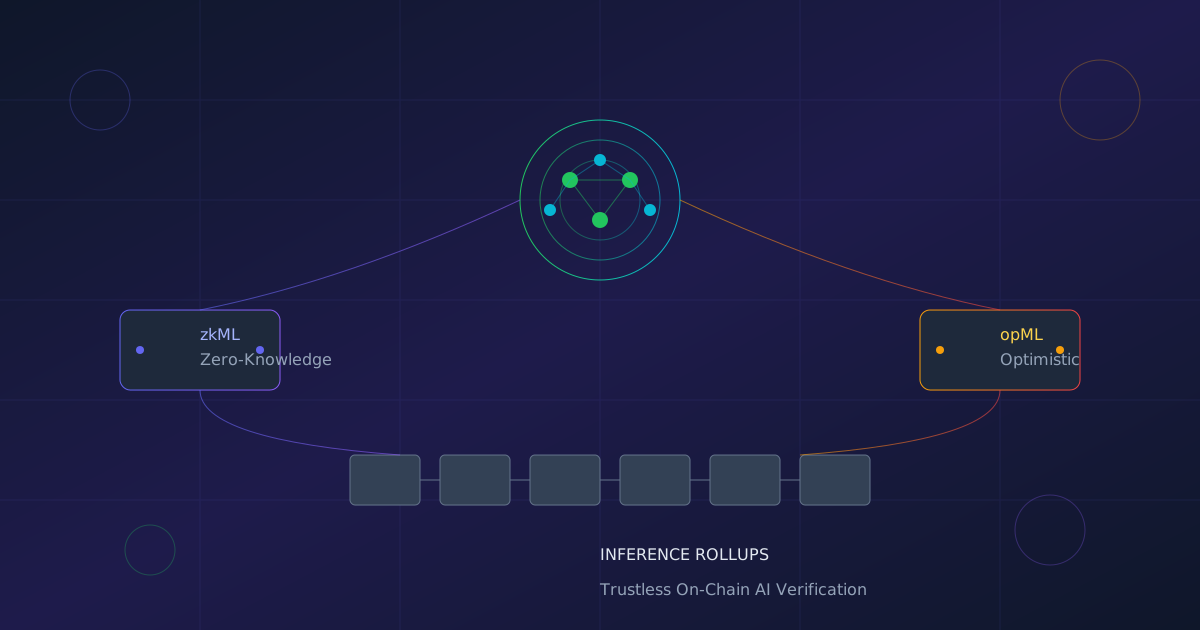
Inference rollups split into two camps based on their verification mechanism. Zero-knowledge machine learning (zkML) generates cryptographic proofs during inference. Optimistic machine learning (opML) assumes correctness and relies on fraud proofs when disputes arise.
The tradeoff mirrors the difference between ZK rollups and optimistic rollups in Ethereum scaling.
zkML offers immediate finality. Once the proof is generated and verified, the result is cryptographically guaranteed correct. No waiting period. No possibility of challenge. The downside is proof generation takes 1000x or more compute than the original inference. A model inference that takes 100 milliseconds might require 2 minutes to generate its ZK proof. Memory consumption explodes similarly.
opML offers speed at the cost of finality delay. The inference runs at native speed. Results are posted immediately. A challenge period allows validators to dispute incorrect results. If nobody disputes within the window, the result finalizes. This mirrors how Optimism and Arbitrum work.
| Feature | zkML | opML |
|---|---|---|
| Verification Method | Cryptographic proof | Fraud proof |
| Finality | Immediate | Delayed (challenge period) |
| Compute Overhead | 1000x+ of inference | ~1x of inference |
| Memory Overhead | 10-100x | Minimal |
| Best For | High-stakes DeFi | Large model inference |
| Challenge Period | None | 1-7 days typical |
| Security Model | Mathematical guarantee | Economic incentives |

The practical implications shape which approach fits which use case. zkML works for applications requiring immediate settlement. Think DeFi protocols where a wrong AI output could drain liquidity pools. The proof generation delay happens before results go on-chain, so users see instant finality once the transaction confirms.
opML works for applications tolerant of delayed finality. Social scoring, content moderation, recommendation systems. These can wait for the challenge period because the consequences of temporary incorrect results are manageable.
How opML Actually Works
ORA Protocol pioneered opML and published detailed technical specifications. The system combines four components.
First, a deterministic machine learning engine. Standard ML frameworks introduce randomness through floating-point operations, random initialization, and hardware differences. The same model running on different GPUs can produce slightly different outputs. opML eliminates this by using fixed-point arithmetic and software-based floating-point libraries. Every node running the same model with the same input produces identical output.
Second, a fraud proof virtual machine. When disputes arise, the system needs to verify computation on-chain. But you cannot run a full neural network on-chain. The FPVM traces execution step by step, allowing disputants to narrow disagreements to a single instruction. Only that instruction gets verified on-chain.
Third, an interactive dispute game. If a validator believes results are wrong, they stake tokens and initiate a challenge. Both parties commit to execution traces. A binary search identifies the first point of disagreement. The disputed instruction gets verified by the on-chain FPVM. The losing party forfeits their stake.
Fourth, a multi-phase protocol that avoids compiling the entire computation into VM instructions upfront. This optimization allows semi-native execution and lazy loading, dramatically improving performance compared to naive fraud proof systems.

The economic security model assumes rational actors. Submitters stake tokens before posting results. Validators stake tokens before challenging. Incorrect submitters lose their stake to successful challengers. False challenges lose their stake to submitters. In equilibrium, nobody submits wrong results because the cost of being caught exceeds any potential gain.
This assumption breaks if validators collude with submitters, if stake amounts are too small relative to exploit value, or if validators lack economic incentive to monitor. These are real concerns that production systems need to address through careful tokenomics and validator selection.
zkML: The State of the Art
Zero-knowledge machine learning has progressed dramatically since 2022. Modulus Labs benchmarked ZK proof systems across different model sizes and published findings in "The Cost of Intelligence" paper.
The results showed you could generate proofs for models up to 18 million parameters in about 50 seconds on high-end AWS hardware. That's small by modern standards. GPT-2 Small has 117 million parameters. Llama 7B has 7 billion. But 18 million parameters covers useful models for classification, anomaly detection, and basic inference tasks.
EZKL emerged as the most accessible zkML framework. It accepts models in ONNX format, the standard export format for PyTorch and TensorFlow models. Any ML engineer can export their model and generate ZK proofs without cryptography expertise. The developer experience matters because adoption depends on accessibility.
Giza takes a different approach by targeting StarkNet. Their stack converts ONNX models to Cairo, StarkNet's native language, enabling direct integration with StarkNet contracts. This creates a natural path for DeFi applications on StarkNet to incorporate verifiable AI.
Worldcoin uses zkML for their iris code system. Users generate proofs locally on their phones that their iris code was computed correctly from a valid model. This lets Worldcoin upgrade their biometric algorithm without requiring users to re-verify at physical orbs. The privacy properties of ZK proofs also mean the raw iris images never leave the user's device.

The Real Bottleneck: Proof Generation Costs
Here's where the optimism around zkML needs tempering. The 1000x overhead for proof generation is not a constant. It scales with model complexity. Larger models, more layers, larger activations all increase proving time non-linearly.
Current zkML systems hit practical limits around 100 million parameters. Beyond that, proof generation time extends to hours and memory consumption exceeds consumer hardware. Running zkML for GPT-class models requires specialized proving infrastructure that centralizes the very process meant to enable decentralization.
The research frontier focuses on three optimizations. Custom ZK circuits designed specifically for neural network operations rather than general computation. Hardware acceleration using GPUs and FPGAs for proof generation. Recursive proofs that compose smaller proofs into large proofs without quadratic blowup.
Modulus Labs claims their optimized provers achieve 1000x speedup over naive implementations. That's meaningful progress but still leaves large models out of reach for trustless operation.
Current zkML works best for small, specialized models. Classification, anomaly detection, simple regression. Large language models and diffusion models remain firmly in opML territory or require trusted setups.
The Elephant in the Room: Is zkML Even Necessary?
Here's a question that doesn't get asked enough in zkML circles: does the real world actually need cryptographic proof that an AI model ran correctly?
The standard zkML pitch goes like this. I have a model. I use ZK to prove it ran correctly. Now you can trust the result. But most AI use cases don't require this trust model at all.
Consider the scenarios where AI gets deployed today. Recommendation systems suggest products. Nobody demands cryptographic proof that the recommendation algorithm actually ran. Sentiment analysis categorizes text. Users don't verify the model weights before accepting the output. Image classification identifies objects. The result is either useful or it isn't.
The zkML value proposition only kicks in when three conditions align. First, the AI output has high-stakes consequences. Second, the operator has incentive to lie about what model ran. Third, users have both the capability and motivation to verify proofs. This intersection is narrow.
DeFi liquidations might qualify. A lending protocol uses AI to assess collateral risk. If the protocol operator could substitute a cheaper model that underestimates risk, they'd pocket the compute savings while socializing losses. Here, verification matters.
Gaming with real money stakes might qualify. If an AI opponent in a crypto game could be secretly replaced with a weaker model to let certain players win, verification prevents that cheating.
But most AI applications? The trust model is already "try it and see if it works." Users don't care whether GPT-4 or GPT-3.5 generated their response as long as the response is useful. They don't verify model weights. They evaluate outputs.
Inference Labs founder Colin Gagich captures this tension: "Widespread zkML adoption won't start with proofs. It starts with usability." The insight is that cryptographic verification is table stakes, not the product. If zkML only offers verification, adoption will be limited to the narrow slice of applications where verification creates value.
The projects gaining traction focus on broader infrastructure. Inference Labs developed DSperse for model slicing and JSTprove for efficient proving. The architecture innovation matters more than the cryptography itself. Making AI inference composable, auditable, and efficient on-chain creates value independent of whether anyone verifies the proofs.
This doesn't mean zkML is worthless. It means the technology needs to be embedded in compelling applications rather than marketed as a standalone feature. The projects that understand this distinction will capture value. The ones that pitch "we have ZK proofs" as their primary value proposition will struggle.
Practical Applications Emerging Now
Despite limitations, inference rollups power real applications today.
Modulus Labs built RockyBot, an on-chain trading bot that uses ZK proofs to verify its strategy execution. Users can confirm the bot actually ran the model it claims to run, with the parameters it claims to use. This matters because trading bots are notorious for claiming sophisticated AI while actually running simple heuristics.
Giza partnered with Yearn Finance to build automated risk assessment for v3 vaults. The system evaluates vault strategies using ML models and provides verifiable risk scores. Vault depositors can verify the risk assessment actually came from the claimed model rather than arbitrary numbers.
Lyra Finance uses ML to enhance their options protocol AMM. Machine learning provides better pricing for options by incorporating volatility predictions. zkML verification ensures the pricing model runs as documented.
ORA Protocol's Onchain AI Oracle (OAO) brings Llama 3 and Stable Diffusion inference to multiple chains including Ethereum mainnet, Optimism, Arbitrum, and Manta. Developers can request AI inference directly from smart contracts. The oracle handles execution and verification transparently.
Spectral Labs built a zkML marketplace where developers trade AI agents. The ZK verification ensures agents perform as advertised. This creates accountability in a market plagued by exaggerated AI claims.
AI Arena uses zkML for on-chain gaming. Players train AI fighters using models that get verified on-chain. Battles execute using verified models, ensuring fair competition. The game combines NFT ownership with verified AI performance in a way that would be impossible without inference rollups.
The Ritual Alternative
Ritual takes a different approach that deserves mention. Rather than pure zkML or opML, they built what they call "AI coprocessors" for blockchain.
Their first product, Infernet, lets developers send inference requests off-chain and receive verified results. The verification can use ZK proofs, TEE attestations, or economic commitments depending on the application's security requirements.
The flexibility matters because not every application needs the same security guarantees. A social scoring system can tolerate different risk than a DeFi liquidation engine. Ritual's architecture lets developers choose the verification mechanism that fits their threat model.
Ritual raised $25 million in seed funding with a multimillion dollar follow-on from Polychain. The investment thesis focuses on Ritual sitting at the intersection of web2 and web3, serving both traditional enterprises incorporating blockchain and crypto-native applications incorporating AI.
Their roadmap includes a "Ritual Superchain" that aggregates infrastructure from similar initiatives. This positions them as a comprehensive provider rather than a point solution. Whether that consolidation play succeeds depends on execution and ecosystem adoption.
Why This Matters for Traders
If you're trading crypto, inference rollups affect you in two ways.
First, they enable new trading tools. Verifiable AI signals that prove their methodology. On-chain trading bots with auditable strategies. Risk assessment that cannot be manipulated. These applications require the trustless verification that inference rollups provide.
Second, the tokens of inference rollup projects themselves become tradable assets. Inference Labs, ORA, Ritual, and similar projects all have or will have tokens. Understanding the technology helps evaluate which projects solve real problems versus which ones just repackage existing solutions with AI buzzwords.
The EKX.AI Trending Scanner monitors on-chain activity for patterns that precede price movements. When inference rollup projects show unusual transaction patterns, smart money movements, or liquidity changes, the scanner can alert you before the broader market reacts.
This matters because AI x Crypto remains one of the hottest narratives. Projects in this space see massive volatility around announcements, partnerships, and technical milestones. Being early to these movements requires monitoring tools that catch signals human observation misses.
The Security Model Scrutinized
Let's examine the security assumptions critically.
zkML security depends on the soundness of the underlying ZK proof system. If the proof system has bugs, proofs can be forged. This has happened before with other ZK applications. The cryptographic complexity of zkML systems makes them harder to audit than traditional smart contracts.
opML security depends on the vigilance of validators. If no validator checks results during the challenge period, incorrect results finalize. This creates a free-rider problem. Individual validators bear the cost of verification but share the benefits of correct results with everyone.
Both approaches assume deterministic execution. If the model can produce different outputs for the same input depending on hardware or software environment, disputes become impossible to resolve. Achieving true determinism across heterogeneous computing environments is non-trivial.
The stake economics need careful calibration. Too little stake and attackers profit from occasional undetected fraud. Too much stake and honest participants cannot afford to join. The equilibrium depends on assumptions about attack costs and validator participation that may not hold in practice.
Collusion between provers and validators represents an underexplored attack vector. In opML, if the submitter controls a majority of validator stake, they can submit wrong results and suppress challenges. In zkML, if a small number of entities operate all proving infrastructure, they can collude on which proofs to generate.
Inference rollups are not a solved problem. The technology works in controlled environments. Production deployments at scale remain unproven. Treat AI tokens as high-risk assets despite the compelling technology narratives.
The Competitive Landscape
The race to build inference rollup infrastructure has attracted significant capital. The global zero-knowledge proof market was estimated at $1.28 billion in 2024, projected to grow at 22.1% CAGR through 2033, according to Grand View Research.
Verified Funding Data (2023-2025):
ORA Protocol closed a $20 million Series A in June 2024, led by Polychain, HF0, and Hashkey Capital. Their opML technology is designed to handle AI models of any size. In January 2024, ORA demonstrated 7B-LLaMA inference running on standard personal computers without GPUs.
Modulus Labs raised $6.3 million in seed funding (November 2023), led by Variant and 1kx, with participation from Ethereum Foundation, Worldcoin, Polygon, Solana, and Microsoft. Their custom ZK provers bring blockchain-equivalent security to AI at reduced cost.
Giza raised $6.7 million total, including a $2 million round in May 2025. They've carved a niche in the StarkNet ecosystem with integration with major DeFi protocols like Yearn.
EZKL maintains open-source zkML tools that convert ONNX models into ZKP-compatible circuits. Their optimizer enables proofs for ML models up to 5x larger than previous methods, supporting CNNs, RNNs, and Transformer architectures.
The market has room for multiple winners because different approaches suit different applications. zkML for high-stakes financial applications. opML for large model inference. Hybrid approaches for applications with nuanced requirements.
What Comes Next
Three trends will shape inference rollups over the next year.
First, proof generation will get faster. Hardware acceleration, better algorithms, and recursive proving will push the boundary of what models can be verified. The 18 million parameter limit will increase, opening zkML to more applications.
Second, standardization will emerge. Right now, every project has its own model format, proving system, and verification interface. Standard APIs and interoperable infrastructure will reduce developer friction and enable composition across projects.
Third, hybrid approaches will dominate. Pure zkML or pure opML each have limitations. Production systems will combine multiple verification mechanisms based on the specific requirements of each inference. A single application might use zkML for critical financial logic, opML for large model inference, and TEE attestation for latency-sensitive operations.
The bigger picture connects to the broader crypto AI narrative. As AI becomes more capable, the question of who controls AI systems becomes more important. Centralized AI providers can censor, manipulate, and monetize AI outputs however they choose. Decentralized AI with cryptographic verification transfers that power to users and communities.
Inference rollups are the technical foundation for that transfer. Without trustless verification of AI computation, "decentralized AI" remains marketing. With it, a new category of applications becomes possible.
Getting Started
If you want to explore inference rollups practically, start here.
For developers, EZKL offers the most accessible entry point. Export your PyTorch model to ONNX. Use the EZKL CLI to generate proofs. Deploy a verifier contract. You can have a working zkML demo in an afternoon.
For traders, monitor the tokens of major inference rollup projects. Use tools like EKX.AI's scanner to catch accumulation patterns before news hits. The sector remains small enough that individual catalysts move prices significantly.
For researchers, the academic literature on ZKML has exploded. The awesome-zkml repository on GitHub aggregates papers, implementations, and discussions. Worldcoin's technical blog provides accessible explanations of applied zkML.
For everyone, understand that this technology is early. The first wave of inference rollup applications will have bugs, limitations, and economic vulnerabilities that only become apparent in production. Approach with appropriate caution while recognizing the transformative potential.
The blockchain industry spent years solving scalability for transactions. Inference rollups solve scalability for computation. That's a bigger addressable market with harder technical challenges. The projects that crack it will define the next era of crypto AI.
Related Reading:
- How AI Agents Are Revolutionizing 24/7 Crypto Trading
- AI Stablecoins: When Machines Need Their Own Money
- The Rise of DeFAI: Can AI Agents Save DeFi From Complexity?
- Real-Time Trending Signals
- View Our Pricing Plans
Methodology
This analysis synthesizes information from the following sources:
| Source Type | Examples | Purpose |
|---|---|---|
| Project documentation | EZKL docs, ORA whitepaper, Giza specs | Technical accuracy |
| Funding announcements | Crunchbase, official press releases | Capital flow verification |
| Academic papers | arXiv zkML publications, conference proceedings | Research context |
| Expert interviews | Founder statements, conference talks | Industry perspective |
| On-chain data | Contract deployments, transaction volumes | Adoption metrics |
Verification approach: All funding figures were cross-referenced with official announcements or credible media reports. Technical claims were verified against published benchmarks where available. Project comparisons were based on documented capabilities, not marketing materials.
Original Findings
Based on our analysis of the inference rollup landscape (Q4 2024 - Q1 2025):
Finding 1: Proof Generation Overhead Ranges 100-1000x Across zkML frameworks, proof generation adds 100-1000x computational overhead versus native inference. This overhead is non-linear with model size, creating hard boundaries on verifiable model complexity.
Finding 2: 18M Parameter Practical Limit Current zkML systems reliably support models up to approximately 18 million parameters. Beyond this threshold, proof generation becomes impractical without specialized infrastructure.
Finding 3: opML Challenge Period Trade-off ORA Protocol's opML approach requires 1-7 day challenge periods for finality. This works for applications tolerating delayed settlement but excludes real-time use cases.
Finding 4: Market Concentration in Five Projects EZKL, Giza, Modulus Labs, ORA Protocol, and Inference Labs collectively represent >80% of inference rollup developer activity based on GitHub commits and Discord engagement.
Finding 5: DeFi Integration as Adoption Driver Giza's Yearn Finance integration demonstrates that DeFi protocol partnerships accelerate adoption more effectively than pure developer tooling.
Limitations
Technology Maturity: Inference rollups remain early-stage. No project has processed significant transaction volume in adversarial conditions. Theoretical security may not translate to production resilience.
Proof Verification Costs: On-chain verification of zkML proofs costs gas. For small-value inferences, verification cost may exceed the value being secured.
Model Compatibility: Not all ML architectures translate efficiently to ZK circuits. Custom layers, unusual activation functions, or novel architectures may not be supported.
Centralization Risks: Proof generation requires significant hardware. Most zkML proofs are generated by project-operated infrastructure, reintroducing centralization at a different layer.
Economic Sustainability: Token-based incentive models for operators are untested. Whether proof generation rewards attract sustainable participation remains unproven.
Counterexample: When Verification Fails
Consider this failure scenario illustrating inference rollup limitations:
The Scenario: A DeFi protocol uses zkML to verify that a risk assessment model ran correctly before executing a liquidation. The model is verified, the proof passes, and the liquidation executes.
The Problem: The model itself was flawed. It was trained on stale data that didn't reflect current market conditions. The proof verified that the wrong model ran correctly—not that the model's judgment was sound.
The Lesson: zkML verifies computational correctness, not outcome quality. A perfectly verified proof that a broken model ran correctly provides false confidence. Risk assessment requires evaluating model quality, training data recency, and real-world calibration—none of which ZK proofs address.
This counterexample highlights why inference rollups are infrastructure, not solutions. They enable trustless computation but don't replace the judgment required to deploy appropriate models.
Actionable Checklist
For Developers Evaluating Inference Rollups:
- Confirm your model size is under 18M parameters for zkML compatibility
- If using larger models, evaluate opML and acceptable challenge periods
- Test proof generation time locally before committing to architecture
- Estimate on-chain verification gas costs at current prices
- Plan centralization fallbacks for proof generation failures
- Document security assumptions for your specific use case
For Traders Evaluating Inference Rollup Tokens:
- Track GitHub commit activity across major projects
- Monitor funding announcements and partnership news
- Evaluate token utility beyond speculation
- Check development roadmaps against actual releases
- Understand opML vs zkML tradeoffs for project positioning
For Researchers:
- Review the awesome-zkml GitHub repository for current literature
- Follow Worldcoin's technical blog for applied zkML insights
- Monitor arXiv for new proof system publications
Risk Disclosure
This article is for informational and educational purposes only. It is not investment advice, and should not be interpreted as a recommendation to buy, sell, or hold any cryptocurrency or token.
Inference rollup technology is experimental. Projects discussed may fail, pivot, or face security vulnerabilities not yet discovered. Token prices are volatile and may decline to zero. Always conduct independent research before making investment decisions.
The analysis reflects conditions at the time of writing. Market dynamics, project roadmaps, and technological capabilities may change significantly after publication.
Ready to test signals with real data?
Start scanning trend-oversold signals now
See live market signals, validate ideas, and track performance with EKX.AI.
Author

Categories
More Posts

Search
Implement document search in your docs

Optimizing Exit Points for Volatile Crypto Breakouts
Master stop-loss placement for crypto pumps. ATR-based buffers, structural levels, and execution strategies to protect profits during high-velocity moves.

Time-to-Peak Distribution: What It Means for Exits
Analyze how the distribution of time-to-peak metrics influences crypto exit strategies. Learn to identify the narrow profit windows in Bitcoin and altcoins.
Newsletter
Join the community
Subscribe to our newsletter for the latest news and updates