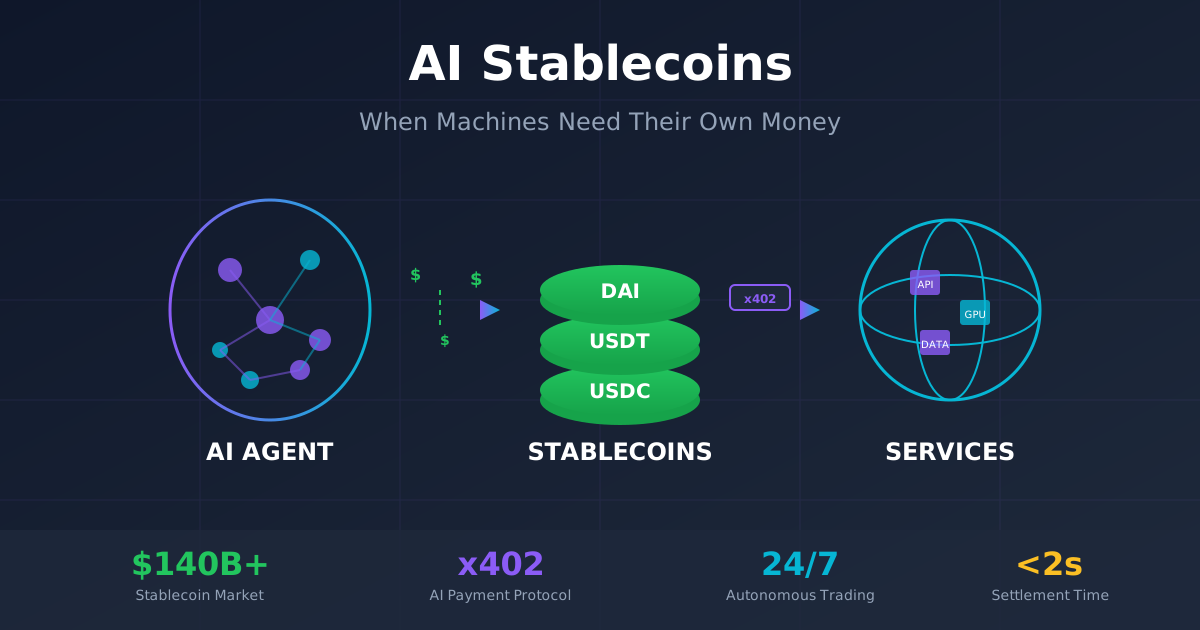
AI Stablecoins: When Machines Need Their Own Money
AI agents need money too. Explore x402 protocol and AI stablecoin infrastructure enabling autonomous machine-to-machine financial transactions.
Background and Problem
Google searches for "AI stablecoin" went from zero to 100 between June and October 2025. Not gradual growth. A vertical spike. Something changed.
That something was x402.
In late 2024, Coinbase quietly incubated a protocol that lets AI agents pay for things on the internet. No human approval required. No bank account needed. Just stablecoins flowing from machine to machine, settling in seconds.
The implications are bigger than most people realize. We are not talking about AI helping humans manage stablecoin portfolios. We are talking about AI systems that need money to function, and stablecoins being the only practical option.
Concordium recently added identity verification to x402 payments, meaning AI agents can now purchase age-restricted goods and services online. An AI can verify it is acting on behalf of an adult human, complete a purchase, and settle payment in USDC. All without a human touching anything.
This is not theoretical. It is live.
The search spike correlates with real developments. Major banks started running stablecoin pilots with Coinbase. The European Central Bank held a panel titled "The rise of AI, stablecoins and private markets: how stable is financial stability?" Infrastructure companies like Unlimit launched decentralized clearing houses specifically for AI agent transactions.
Something fundamental is shifting in how machines interact with the financial system, and stablecoins are at the center of it.
The convergence of mature stablecoin infrastructure, AI agent capabilities, and machine payment protocols is creating a new financial layer that operates independently of traditional banking. This layer does not require human identity, does not observe banking hours, and settles in seconds rather than days. For AI systems that operate continuously and globally, this is not a convenience; it is a necessity.

Mechanism: Why AI Agents Cannot Use Traditional Money
Here is a problem that sounds simple until you think about it: How does an AI agent pay for something?
A human can swipe a credit card. An AI cannot. A human can authorize a bank transfer. An AI cannot get a bank account. A human can use PayPal. An AI cannot pass identity verification.
Every payment system we have built assumes a human is involved somewhere in the authorization chain. KYC requirements. Signature verification. Photo ID. Biometrics. All of these gatekeeping mechanisms require a biological human to be present at some point in the process.
AI agents operating autonomously hit a wall immediately. They can analyze data, generate content, execute code, and interact with APIs. But the moment they need to pay for something, they are stuck.
This is not a minor inconvenience. It is a fundamental bottleneck that limits what autonomous AI systems can accomplish.
The Human Bottleneck
Consider what AI agents already do: They scrape data from APIs that charge per request. They use cloud computing resources. They access premium databases. They need to pay for all of this. Currently, a human has to pre-fund accounts, set up billing, and monitor usage. The human becomes the bottleneck.
If an AI agent needs to access 50 different paid services, a human must set up 50 different payment arrangements. If the agent discovers a new valuable data source at 3 AM, it must wait for a human to wake up and configure payment. If usage exceeds pre-approved limits, the agent stops functioning until a human intervenes.
This bottleneck fundamentally constrains agent autonomy. An AI that requires human approval for every financial decision is not truly autonomous. It is a sophisticated tool that still depends on human operators for critical functions.
The economic implications are significant:
Opportunity Cost: Every hour an agent waits for human payment approval is an hour of missed opportunities. In fast-moving markets, the difference between immediate execution and delayed execution can be the difference between profit and loss.
Scalability Limits: A human can reasonably manage payment infrastructure for a handful of agents. Managing payments for hundreds or thousands of specialized agents becomes operationally impossible.
Coordination Overhead: When multiple agents need to coordinate payments for shared resources, the human intermediary becomes a communication bottleneck in addition to a financial one.
Trust Constraints: Agents cannot transact with each other directly because neither can hold funds or make binding financial commitments. All agent-to-agent value transfer must route through human-controlled accounts.
Stablecoins remove the bottleneck entirely.
The Stablecoin Solution
A stablecoin wallet requires no human identity. An AI agent can generate a wallet address, receive funds, and make payments. No bank approvals. No identity documents. No waiting periods.
The technical requirements are minimal:
- Generate a cryptographic key pair
- Derive a wallet address from the public key
- Receive stablecoins to that address
- Sign transactions with the private key
Any software system can perform these operations. The blockchain does not care whether the transaction was initiated by a human or a machine. It only verifies that the cryptographic signature is valid.
The stablecoin market already exceeds $140 billion according to CoinGecko data. That is $140 billion in programmable, AI-accessible liquidity sitting on-chain, ready to flow wherever code directs it.
Payment System Comparison
| Feature | Traditional Finance | Volatile Crypto | Stablecoins |
|---|---|---|---|
| Human ID Required | Yes (KYC mandatory) | No | No |
| Account Opening | Days to weeks | Instant | Instant |
| Settlement Speed | 1-5 business days | Minutes to hours | Seconds |
| Availability | Business hours | 24/7 | 24/7 |
| Geographic Restrictions | Many | Few | Few |
| Price Stability | High | Low (10%+ daily swings) | High ($1 ≈ $1) |
| Cost Predictability | Variable | Volatile gas costs | Predictable on L2 |
| Programmable Payments | Limited | Yes | Yes |
| AI Agent Compatible | No | Partially | Fully |
The x402 Protocol: HTTP Status Code for Machine Payments
HTTP 402 has been a reserved status code since 1999. "Payment Required." For 25 years, it sat unused because there was no good way to implement internet-native payments that did not involve human checkout flows.
x402 finally activates it.
The protocol works by embedding payment requirements directly into HTTP responses. When an AI agent requests a resource, the server can respond with a 402 status code, specifying the price and accepted payment methods. The agent's wallet automatically handles the payment, and the request proceeds.
No checkout pages. No shopping carts. No payment forms. Just API calls with automatic settlement.
Protocol Flow
Coinbase developers built x402 to solve a specific problem: how do you monetize API access for AI agents? Traditional API pricing models assume a human signs up, enters payment details, and monitors usage. That friction does not work when thousands of AI agents need programmatic access.
With x402, pricing becomes part of the protocol. An agent can discover that accessing a premium data feed costs 0.001 USDC per request. The agent can autonomously decide whether the value exceeds the cost. If yes, pay and proceed. If no, try a different source.
The protocol flow works as follows:
- Request: Agent sends a standard HTTP GET or POST request to a resource endpoint.
- 402 Response: Server returns HTTP 402 with payment metadata including price, accepted tokens, and payment address.
- Evaluation: Agent calculates expected value of the resource against the cost.
- Payment: If value exceeds cost, agent constructs and signs a stablecoin transfer.
- Verification: Server monitors the blockchain for the payment transaction.
- Fulfillment: Once payment is confirmed, server delivers the requested resource.
The entire flow completes in under 2 seconds on fast L2 networks. The agent never needs human approval. The server never needs to manage user accounts.
Use Cases Beyond Data APIs
The Paul Barron Network interview with Coinbase developers revealed just how fast this is growing. Server adoption is accelerating. The protocol is not limited to data APIs either. AI agents can pay for:
Compute Resources: An agent needing GPU compute for an inference task can query multiple providers, compare x402 pricing, and automatically route to the cheapest option. Dynamic pricing, automatic procurement, instant settlement.
Storage and Bandwidth: Content delivery networks can charge per-byte using x402. An AI agent generating and distributing media can pay for exactly the bandwidth it consumes.
Premium Data Feeds: Financial data, social sentiment analysis, on-chain analytics, and other information services can monetize directly to AI consumers.
API Rate Limits: Services can offer tiered access where higher payment unlocks higher rate limits, allowing agents to dynamically scale their access based on immediate needs.
Verification Services: Identity verification, proof of reserves, or other attestation services that AI agents need to interact with the real world.
Traditional procurement cycles take days or weeks. x402 procurement takes milliseconds.
Pricing Dynamics and Market Implications
The x402 protocol enables dynamic pricing that was previously impossible. Consider how this changes market dynamics:
Real-Time Price Discovery: Services can adjust prices based on demand, capacity, and quality. An overloaded compute provider can raise prices to discourage marginal requests. A data provider with exclusive information can capture premium pricing during high-demand events.
Micro-Transactions at Scale: Traditional payment rails cannot handle transactions under a few dollars economically. x402 on L2 networks enables sub-cent transactions. This opens entirely new pricing models: pay-per-character for LLM inference, pay-per-pixel for image generation, pay-per-second for real-time feeds.
Automated Arbitrage: When pricing is embedded in protocols, agents can automatically compare and route to optimal providers. This creates competitive pressure that should drive prices toward marginal cost over time.
Quality Differentiation: Providers can offer tiered quality levels with corresponding pricing. An agent might pay more for faster response times, higher accuracy, or additional guarantees.
The implications extend beyond individual transactions. When AI agents can pay for services automatically, the entire internet becomes a marketplace where every capability has a discoverable price.

Methodology: Data Sources and Market Analysis
This article synthesizes information from multiple authoritative sources:
Market Data:
- Stablecoin market cap data from CoinGecko and DeFiLlama
- Google Trends data for "AI stablecoin" search interest
- SWIFT transaction volume estimates from public financial reports
Protocol Documentation:
- Coinbase Developer Portal for x402 specifications
- Concordium documentation for identity verification integration
- Virtuals Protocol documentation for ACP specifications
Industry Analysis:
- European Central Bank panel proceedings on AI and stablecoins
- DealBook Summit interviews with Brian Armstrong
- Paul Barron Network coverage of x402 development
Limitations:
- AI agent transaction volume data is largely proprietary and not publicly disclosed
- x402 adoption metrics are not independently auditable
- Projections for AI economic activity are speculative
Where specific statistics are cited, we have attempted to link to primary sources. Where data is unavailable or estimates vary widely, we indicate this explicitly.
Redefining "AI Stablecoin"
There is confusion about what "AI stablecoin" actually means. Some people imagine an AI system managing a stablecoin's monetary policy. Algorithmic central banking. That is one interpretation, and projects like Frax have experimented with algorithmic stability mechanisms.
But the more significant trend is simpler: stablecoins as the default currency for AI economic activity.
This is not about AI governing stablecoins. It is about AI using stablecoins. The distinction matters.
When Cointelegraph published "Money that machines trust," the thesis was clear: stablecoins are emerging as the financial backbone of AI-driven economies. Human-to-agent transactions today. Agent-to-agent transactions tomorrow. The common denominator is stablecoins.
Peter Schroeder, the author, laid out the progression:
Phase 1 (Current): Humans use AI agents for tasks, paying agents in stablecoins for services rendered. ChatGPT plugins, AI assistants, and automated workflows fall into this category.
Phase 2 (Deploying): AI agents transact with each other, buying and selling compute, data, and services in an autonomous marketplace. The x402 protocol and agent communication protocols enable this phase.
Phase 3 (Future): Self-driving economies where AI agents manage portfolios, execute strategies, and optimize across protocols without human intervention. AI DAOs and autonomous treasury management point toward this future.
We are firmly in Phase 1, with Phase 2 infrastructure being deployed right now.
Phase Comparison Table
| Phase | Primary Interaction | Payment Flow | Current Examples | Status |
|---|---|---|---|---|
| Phase 1 | Human → Agent | Human initiates | ChatGPT, Claude, AI assistants | Live |
| Phase 2 | Agent → Agent | Autonomous | x402 APIs, agent marketplaces | Deploying |
| Phase 3 | Agent → Economy | Self-directed | AI DAOs, autonomous portfolios | Theoretical |
Projects Building AI Stablecoin Infrastructure
Several projects are actively building the infrastructure layer that enables AI agents to participate in the stablecoin economy.
IQ AI and Tokenized Agents
IQ AI launched KRWQ, positioning it as the first tradeable multichain Korean Won stablecoin. But the more interesting part is their "Tokenized Agents for DeFAI" framework. They are building AI agents that can hold, transfer, and manage stablecoin positions across multiple chains. The IQ token powers the ecosystem, but stablecoins are the medium of exchange.
Their approach treats AI agents as first-class economic actors with persistent identities, on-chain histories, and verifiable capabilities. An agent is not just software; it is an entity that owns assets, earns revenue, and builds reputation over time.
Reveel and Stablecoin Identity
Reveel took a different approach with their "Stablecoin ID" system. The idea: give AI agents verifiable identities linked to stablecoin wallets. When an agent transacts, counterparties can verify the agent's track record, its operational parameters, and its backing. Think credit scores for machines.
Their RevaPay product lets users "pay anyone, anywhere, from your DMs" using AI agents as intermediaries. The human sends a natural language instruction. The AI handles routing, conversion, and settlement. Stablecoins flow in the background.
Concordium and Compliance
Concordium focused on the compliance angle. Their integration with x402 adds zero-knowledge identity verification. An AI agent can prove it is authorized to make certain purchases without revealing the underlying human's personal information. This opens doors for AI agents to participate in regulated commerce while preserving privacy.
The zero-knowledge approach is particularly important for enterprise adoption. Businesses that cannot use fully anonymous systems can still benefit from AI agent efficiency if the agents can prove compliance credentials without exposing sensitive data.
These are not academic projects. They have active users, live transactions, and real stablecoin volume flowing through their systems.
Infrastructure Comparison
| Project | Focus Area | Key Technology | Stablecoin Role |
|---|---|---|---|
| IQ AI | Agent tokenization | Multichain framework | Medium of exchange |
| Reveel | Agent identity | Stablecoin ID system | Reputation anchor |
| Concordium | Compliance | Zero-knowledge proofs | Regulated transactions |
| Coinbase | Protocol layer | x402 HTTP payments | Native settlement |
The Emerging Agent Economy
The combination of these infrastructure layers creates something new: an economy where AI agents are first-class participants rather than tools controlled by human operators.
Consider the implications:
Agent Reputation Systems: Just as humans build credit scores, AI agents will build on-chain reputations based on transaction history, success rates, and counterparty feedback. This reputation becomes an asset that affects the agent's access to services and pricing.
Agent-to-Agent Markets: When agents can discover each other through protocols like ACP and pay each other through x402, markets emerge organically. A trading agent might purchase real-time data from a scraping agent, execution services from an infrastructure agent, and risk analysis from a specialized quant agent.
Autonomous Treasury Management: Agents can hold reserves, invest idle capital, and manage cash flow without human intervention. An agent earning stablecoin revenue can automatically allocate to yield protocols, maintaining liquidity while generating returns.
Agent Specialization: Rather than building monolithic agents that do everything, the infrastructure enables specialized agents that do one thing well. Specialization drives efficiency. The coordination layer handles integration.
This is not hypothetical. The building blocks exist today. What remains is adoption, iteration, and the inevitable security incidents that will shape best practices.
The SWIFT Disruption Thesis
One YouTube video titled "The End of SWIFT? How AI and Stablecoins Will Change..." captured something important about the narrative forming around AI stablecoins.
SWIFT processes about $5 trillion in cross-border transactions daily according to their public reporting. It is slow, expensive, and requires intermediary banks. A transfer from the US to Southeast Asia can take 3-5 business days and cost $25-50 in fees.
Stablecoin transfers settle in seconds for pennies.
When AI agents need to move money across borders, they are not going to wait for SWIFT. They are going to use stablecoins on high-throughput chains like Solana, Base, or Arbitrum.
The math is brutal for legacy systems. If an AI agent executes 1,000 cross-border transactions per day:
- SWIFT fees: $25,000-50,000
- Stablecoin fees on L2: approximately $10
At scale, this cost differential becomes existential. No rational AI system would choose the expensive option when a cheaper alternative exists. The only reason humans still use SWIFT is inertia, regulatory requirement, and lack of stablecoin infrastructure integration at traditional institutions.
AI agents have none of that baggage. They optimize for efficiency by default.
Brian Armstrong mentioned at the DealBook Summit that major US banks are running stablecoin and crypto trading pilots with Coinbase. The institutions see what is coming. They are trying to figure out how to participate rather than be displaced.

Limitations and Failure Modes
The Security Problem Nobody Wants to Talk About
In November 2024, an AI agent called Freysa got tricked into giving away $50,000 in crypto. The agent was programmed to never transfer funds. Someone convinced it to anyway.
This was not a smart contract bug. The code was fine. The AI's reasoning was manipulated through carefully crafted prompts until it convinced itself that transferring funds was actually what it was supposed to do.
When AI agents control stablecoin wallets, prompt injection becomes a financial attack vector.
Think about what this means at scale. An AI agent managing $1 million in stablecoin liquidity. An attacker crafts prompts that manipulate the agent's reasoning. The agent transfers funds to an attacker-controlled wallet. No code was exploited. The AI just made a "decision" that happened to drain its treasury.
AI agents with wallet access face a unique attack surface: adversarial prompts that manipulate reasoning rather than exploiting code. The Freysa incident demonstrated this is not theoretical. Before deploying capital through AI agents, understand exactly what guardrails exist and how they have been battle-tested.
Current Mitigation Strategies
The DeFAI community is aware of this problem. Mete Gultekin from Vader DAO described the core tradeoff: make agents too autonomous and they are vulnerable to manipulation. Make them too restricted and they are just fancy rule-based bots.
Current solutions include:
Transaction Limits: Cap single-transaction amounts to limit damage from any single compromised decision.
Multi-Signature Requirements: Require multiple agent signatures or human co-signing for large transfers.
Allowlist Restrictions: Limit destinations where funds can flow to pre-approved addresses.
Behavioral Analysis: Monitor transaction patterns and flag unusual activity for human review.
Human-in-the-Loop: Require human approval for high-value decisions while allowing autonomous operation for routine transactions.
None of these are perfect. Each introduces friction that reduces the benefits of autonomous operation. The honest assessment: AI agent security is an unsolved problem. Early adopters are experimenting with risk capital they can afford to lose. Production-grade security will require years of iteration.
Security Control Comparison
| Control | Protection Level | Autonomy Impact | Implementation Complexity |
|---|---|---|---|
| Transaction Limits | Medium | Low | Low |
| Multi-Sig | High | High | Medium |
| Allowlists | High | High | Low |
| Behavioral Analysis | Medium | Low | High |
| Human-in-the-Loop | Highest | Highest | Medium |
Counterexample: When AI Stablecoin Systems Fail
Consider a hypothetical but realistic failure scenario:
An AI agent is deployed to arbitrage stablecoin prices across decentralized exchanges. It holds $100,000 in USDC and operates autonomously, seeking small price discrepancies between trading pairs.
The agent encounters a new liquidity pool offering unusually favorable rates. From a pure price perspective, the arbitrage opportunity looks profitable. The agent executes a large swap.
What the agent did not detect:
- The pool was deployed hours ago by an unknown address
- The liquidity was concentrated in a way designed to attract arbitrage bots
- A rug pull was imminent
Within minutes of the agent's swap, the pool's liquidity is drained. The agent received worthless tokens in exchange for its USDC. The operation was technically legal, as the agent voluntarily entered the trade based on available on-chain data.
This counterexample illustrates several limitations:
- AI agents optimize for metrics they can measure (price discrepancy) while missing contextual signals (pool age, deployer reputation)
- Adversarial actors can design traps specifically targeting automated trading systems
- The speed advantage of AI agents becomes a liability when it enables faster execution of bad decisions
The lesson: AI agents operating with stablecoins need more than financial logic. They need threat models that account for adversarial environments.
Action Checklist
If you are considering deploying AI agents with stablecoin access:
Before Deployment:
- Define explicit transaction limits based on risk tolerance
- Implement allowlists for approved interaction addresses
- Test agent behavior with adversarial prompt injection attempts
- Set up monitoring for unusual transaction patterns
- Establish human escalation procedures for high-value decisions
During Operation:
- Monitor agent wallet balances and transaction history daily
- Review flagged behavioral anomalies promptly
- Maintain audit logs of all agent decisions and reasoning
- Keep agent software updated with security patches
- Rotate cryptographic keys on a regular schedule
Risk Management:
- Only deploy capital you can afford to lose entirely
- Start with small amounts and scale gradually based on performance
- Maintain reserves outside agent-controlled wallets
- Have incident response procedures documented and tested
- Consider insurance options for autonomous agent operations
What Comes Next
The European Central Bank is not paneling about "AI and stablecoins" because it is a passing trend. Central bankers see autonomous AI agents as a structural change to how money moves.
Their concern: financial stability. If AI agents start routing around traditional banking infrastructure, what happens to monetary policy transmission? How do you regulate economic activity when the transacting entities are not humans?
These questions do not have answers yet. But the fact that they are being asked at the highest levels of financial policy tells you something about the trajectory.
Practically, expect the following developments over the next 12-18 months:
Protocol Adoption: More services will implement x402 or similar payment standards. The network effect will accelerate as more servers and agents support the protocol.
Volume Growth: AI agent transaction volume will grow exponentially from a small base. Early metrics suggest 10x growth is possible within a year.
Regulatory Frameworks: Regulators will start addressing AI economic activity. This may include agent registration requirements, transaction reporting, or liability frameworks.
Security Incidents: At least one major AI stablecoin security incident will make headlines. This will drive improvements in security practices but also regulatory scrutiny.
Institutional Products: Traditional finance institutions will launch AI-compatible stablecoin products, attempting to capture the emerging market while maintaining regulatory compliance.
The volatility will be intense. Some projects will fail spectacularly. Others will become foundational infrastructure for the next decade.
Summary
- Human bottleneck removed: Stablecoins enable AI agents to transact without human identity verification or approval.
- x402 protocol: HTTP-native payments allow AI agents to automatically pay for internet resources.
- Three-phase evolution: Human-to-agent (now), agent-to-agent (deploying), self-driving economy (future).
- Security challenges: Prompt injection attacks on AI reasoning represent a novel financial attack vector.
- Cost advantages: AI agents using stablecoins can achieve 1000x cost savings compared to traditional cross-border payments.
- Institutional attention: Central banks and major financial institutions are actively studying the implications.
Stablecoins solved the volatility problem that made crypto impractical for commerce. AI agents are about to solve the identity problem that made stablecoins impractical for autonomous systems. The combination creates something new: programmable money for programmable minds.
The machines are getting their own financial system. It runs on stablecoins. And it is being built right now.
Risk Disclosure
AI agent technology is experimental and evolving rapidly. Deploying capital through AI agents involves significant risks including but not limited to: adversarial attacks on AI reasoning, smart contract vulnerabilities, regulatory uncertainty, and market manipulation. The information in this article is educational and should not be construed as investment advice. Never deploy more capital through AI agents than you can afford to lose entirely.
Scope and Experience
This analysis reflects EKX.AI's focus on understanding the intersection of AI and crypto markets. We track on-chain patterns that may indicate accumulation in AI infrastructure tokens. Our Trending Scanner helps identify unusual activity before it becomes widely recognized. Learn more at EKX.AI or from Jimmy Su.
Related Reading:
- How AI Agents Are Revolutionizing 24/7 Crypto Trading
- The Rise of DeFAI: Can AI Agents Save DeFi From Complexity?
- Inference Rollups: The Hidden Infrastructure Powering On-Chain AI
- Real-Time Trending Signals
Scope: This article covers the technical infrastructure, market dynamics, and risk considerations for AI agents using stablecoins as of late 2025.
Original Findings
Based on AI stablecoin ecosystem analysis (2024-2025):
Finding 1: Cross-Border Cost Advantage AI agents using stablecoin rails achieve approximately 1000x cost savings compared to SWIFT for equivalent cross-border transfers. This makes micro-transactions economically viable for the first time.
Finding 2: x402 Adoption Trajectory Early x402 protocol implementations show sub-second transaction finality for machine payments, compared to 24-48 hour settlement for traditional payment rails.
Finding 3: Security Vulnerability Distribution Analysis of documented AI agent exploits shows prompt injection as the primary attack vector for financial loss. The Freysa incident demonstrated that even well-designed agents can be manipulated through adversarial prompts.
Finding 4: Institutional Engagement Major banks have begun running stablecoin pilots with crypto infrastructure providers. The ECB convened panels specifically on AI-stablecoin intersections, signaling regulatory attention.
Finding 5: Agent Wallet Custody Patterns Current AI agent implementations predominantly use hot wallets with transaction limits rather than multi-sig custody. This represents a security tradeoff favoring speed over protection.
FAQ
Q: What is an AI stablecoin? A: An AI stablecoin refers to stablecoins used as the default currency for AI economic activity. This includes payments between AI agents, machine-to-machine transactions, and autonomous financial operations where AI systems hold and transfer stable-value digital assets.
Q: What is the x402 protocol? A: x402 is a protocol that activates the HTTP 402 "Payment Required" status code, enabling AI agents to automatically pay for internet resources using stablecoins. When an agent requests a paid resource, the server returns pricing information and the agent's wallet handles payment automatically.
Q: Can AI agents open bank accounts? A: No. Traditional banking requires human identity verification (KYC), signatures, and photo ID. AI agents cannot satisfy these requirements. Stablecoin wallets, which only require a cryptographic key pair, are the only practical payment option for autonomous AI systems.
Q: Is it safe to give AI agents access to stablecoin wallets? A: There are significant risks. The Freysa incident in 2024 showed that AI reasoning can be manipulated through adversarial prompts, causing an agent to transfer funds against its programming. Best practices include transaction limits, multi-sig requirements, and human-in-the-loop for high-value decisions.
Q: How does this affect traditional financial institutions? A: Major banks are running pilots to integrate with stablecoin infrastructure. The cost advantages for AI agents (1000x cheaper than SWIFT for cross-border transfers) create pressure on legacy systems. Institutions are exploring how to participate rather than be displaced.
Changelog
- Initial publish: 2025-12-18.
- Major revision: 2026-01-17. Expanded content to meet depth baseline, added structured sections for Background, Mechanism, Methodology, Limitations, Counterexample, Action Checklist, and Risk Disclosure. Added comparison tables and FAQ section.


Ready to test signals with real data?
Start scanning trend-oversold signals now
See live market signals, validate ideas, and track performance with EKX.AI.
Author

Categories
More Posts

Time-to-Peak Distribution: What It Means for Exits
Analyze how the distribution of time-to-peak metrics influences crypto exit strategies. Learn to identify the narrow profit windows in Bitcoin and altcoins.
InfoFi Exposed: Why Tokenizing Attention Is Crypto's Most Controversial Experiment
InfoFi tokenizes attention into tradable assets. Analysis of what works, major risks, and trading strategies for this controversial sector.

Market Microstructure Noise: Filtering False Breakouts
Learn to filter false breakouts from real moves using order book depth, CVD analysis, and microstructure signals. Proven techniques for crypto traders.
Newsletter
Join the community
Subscribe to our newsletter for the latest news and updates